
Currently Empty: ₹0.00
Every year, millions of tonnes of crop residue — commonly known as Parali — are left behind after the harvest of rice and wheat across India. For decades, farmers burned this stubble to quickly clear their fields, creating thick blankets of smog over northern India, especially in Punjab, Haryana, and Delhi. But today, a powerful and eco-friendly solution has emerged: Parali Paper.
What is Parali?
Parali is the term used in northern India — particularly in Punjab and Haryana — for the leftover crop residue (stubble) after harvesting paddy (rice) and wheat. After the combine harvester cuts the grain, a large amount of straw remains in the field. Approximately 20 million tonnes of rice stubble are produced every year in Punjab alone, with around 80% of it historically being burned on-site to prepare fields quickly for the next sowing season.
The Problem with Stubble Burning
Stubble burning releases hazardous greenhouse gases such as carbon dioxide (CO₂), methane (CH₄), carbon monoxide (CO), and nitrogen dioxide (NO₂) into the atmosphere. This practice is a major contributor to the air pollution crisis in Delhi and the surrounding NCR region every winter, causing dangerous smog that affects millions of people. Beyond air pollution, burning stubble also degrades soil health, kills beneficial soil organisms, and depletes nutrients that are vital for future crops.
What is Parali Paper?
Parali Paper — also called Farmer Paper or Stubble Paper — is a type of eco-friendly paper made from agricultural waste, specifically crop residues like paddy straw, wheat straw, sugarcane bagasse, and other farm leftovers. Instead of sending this waste up in smoke, it is collected, processed, and converted into high-quality paper and paper products. The fibrous nature of paddy straw makes it an excellent raw material for paper production. In fact, for manufacturing paper, paddy straw and wheat straw are typically used together in a ratio of 40:60.
How is Parali Paper Made?
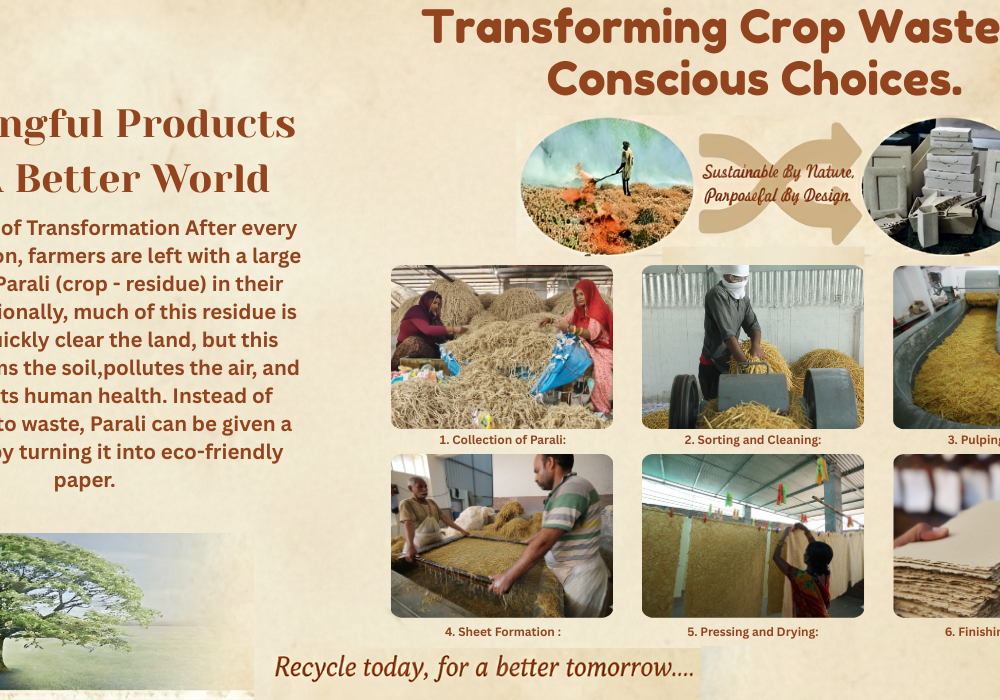
The process of making Parali Paper involves several key steps:
- Collection: Crop stubble is collected from farmers’ fields instead of burning it.
- Soaking & Pulping: The straw is soaked in water and broken down into pulp.
- Mixing: Paddy straw pulp is mixed with wheat straw pulp, often in a 40:60 ratio.
- Sheet Formation: The pulp is spread on screens to form sheets of paper.
- Drying & Finishing: Sheets are dried, pressed, and finished into usable paper products.
- Biomethanization: The sludge left over from paper production can be used to generate electricity — fulfilling up to 60% of a paper mill’s energy requirements.
Key Benefits of Parali Paper
- Reduces Air Pollution: By diverting crop residue from burning, Parali Paper directly cuts down on the release of harmful gases and particulate matter.
- Saves Trees: Using agricultural waste as a raw material reduces dependence on wood-based pulp, helping prevent deforestation.
- Extra Income for Farmers: Farmers can sell their stubble to paper mills instead of burning it, creating an additional revenue stream.
- Sustainable & Circular Economy: Waste that was once a liability becomes a valuable resource, supporting a zero-waste agricultural cycle.
- Energy Generation: The by-products of Parali Paper manufacturing can be used for biomethanization to generate green energy.
- Handmade Products: Many Parali Paper products — such as notebooks, stationery, and packaging — are handcrafted, supporting artisan livelihoods.
Parali Paper in India: Success Stories
Punjab’s Parali Paper Revolution
Punjab — often referred to as the “Granary of India” — is one of the leading states adopting Parali Paper. The Punjab government, in collaboration with NGOs and private enterprises, has launched projects to convert agricultural waste into Farmer Paper. These initiatives give farmers an alternative to burning, significantly reducing pollution levels while also generating additional income for rural communities. Several local paper mills have adapted their facilities to process this stubble into high-quality paper for both domestic and international markets.
CSIR’s Innovation
The Council of Scientific and Industrial Research (CSIR), through its Advanced Materials and Processes Research Institute (CSIR-AMPRI) in Bhopal, has developed an internationally patented technology for making eco-friendly hybrid plywood and composite wood using parali and other industrial waste materials. This technology has been licensed to industry, contributing to the government’s Atmanirbhar Bharat initiative by creating employment and improving farmer livelihoods.
Products Made from Parali Paper
Parali Paper is versatile and can be used to make a wide range of products, including:
- Eco-friendly notebooks and diaries
- Stationery items (envelopes, writing pads, cards)
- Packaging material and cardboard boxes
- Handcrafted decorative items
- Disposable utensils and plates
- Boards and composite wood panels
Why Choose Parali Paper?
When you choose Parali Paper products, you are not just buying a notebook or a sheet of paper. You are making a conscious choice to support farmers, reduce air pollution, and protect forests. Every product made from Parali Paper represents a step toward a greener India — one where agricultural waste fuels innovation rather than fires.
At Farmer Paper, we are proud to be part of this sustainable revolution. Our products are crafted from genuine crop stubble, ensuring that each purchase helps a farmer earn more while the environment breathes easier.
Conclusion
Parali Paper is more than just an eco-friendly product — it is a movement. It addresses the twin challenges of agricultural waste management and sustainable resource use. By converting farm waste into premium paper, we can reduce environmental pollution, conserve forests, and create economic opportunities for India’s rural communities. The success stories from Punjab and other states across India demonstrate that Parali Paper has the potential to transform the way we think about waste, farming, and sustainability.

